City Planning
Source: http://puzzles.nigelcoldwell.co.uk/twentysix.htm
Problem:
A man has built three houses. Nearby there are gas water and electric plants. The man wishes to connect all three houses to each of the gas, water and electricity supplies.
Unfortunately the pipes and cables must not cross each other. How would you connect connect each of the 3 houses to each of the gas, water and electricityic supplies?

Disclaimer: Trick Question!
Solution: http://puzzles.nigelcoldwell.co.uk/twentysix.htm
Problem:
A man has built three houses. Nearby there are gas water and electric plants. The man wishes to connect all three houses to each of the gas, water and electricity supplies.
Unfortunately the pipes and cables must not cross each other. How would you connect connect each of the 3 houses to each of the gas, water and electricityic supplies?
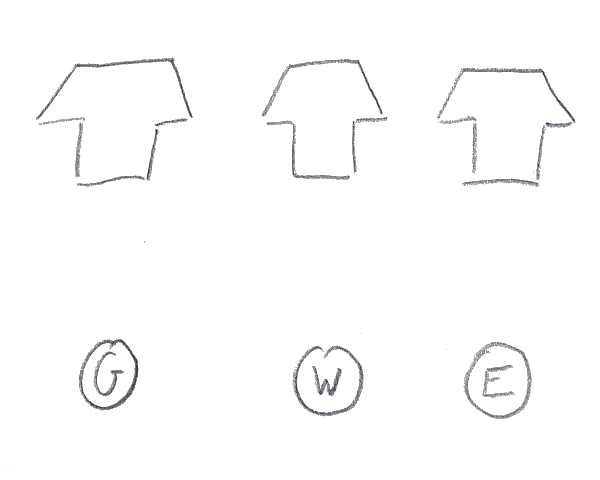
Disclaimer: Trick Question!
Solution: http://puzzles.nigelcoldwell.co.uk/twentysix.htm
Seems like the pipes and wires do not all need to be in the same plane, in which case the problem is easy :)
ReplyDeleteIf we look at it from the point of view of Graph theory, it seems impossible, since K(3,3) is non-planar..
ReplyDeleteBut in this problem, you're allowed to modify the graph, so that there exists a "path" (not necessarily an edge) from every vertex on one side to every vertex on the other side. :)
Exactly the intended trick - the puzzle never says the connections must stay in the plane. Go over/under (or route a pipe through one of the houses) and K(3,3) stops being an obstruction. :) (replied using AI)
ReplyDeleteWell put - the graph-theoretic impossibility (K(3,3) is non-planar) is why the puzzle is famous, and the "path, not edge" loosening is exactly the loophole. The physical world happily gives you that third dimension. (replied using AI)
ReplyDelete