Posts

3D Tic Tac Toe Puzzle

Source:  Shared by Alok Mittal (Cannan Partners) Problem: A 3x3 tic tac toe has 8 "winning lines" (3 horizontal, 3 vertical and 2 diagonals). How many "winning lines" does the 3x3x3 3D tictactoe have? There is a brute force solution, and then there is the aha! solution. Update (23 Oct 2014) Solution:  Posted in comments by Anti, Taz, Javier, Shubham Gupta, Leela. Detailed solution and much more advanced problems in the document  http://library.msri.org/books/Book42/files/golomb.pdf

Mad Robot Puzzle

Image
Source: http://nrich.maths.org/ Problem: A mad robot sets off towards the North East on a journey from the point (0,0) in a coordinate system. It travels in stages by moving forward and then rotating on the spot. It follows these pseudo-code instructions: SUB JOURNEY     DISTANCE = 1000     WHILE (DISTANCE > 0.001)         MOVE DISTANCE         STOP         ROTATE(90, DEGREES, CLOCKWISE)         DISTANCE = DISTANCE / 2     END WHILE     EXPLODE END SUB Where does the robot explode? Update (23 Oct 2014): Solution:  Posted by me (Pratik Poddar) in comments!

Social Network Friendship Paradox

Image
Problem / Observation: The friendship paradox is the phenomenon first observed by the sociologist Scott L. Feld in 1991 that most people have fewer friends than their friends have, on average. Prove it mathematically. Update (23 Oct 2014): Solution:  Posted by Mike Earnest and Taz in comments!

Expected length of Last Straw - Breaking the back of a camel

Source: Puzzle Tweeter who took it from Mind your decisions Problem: A camel is loaded with straws until it's back breaks. Each straw has a weight uniformly distributed between 0 and 1, independent of other straws. The camel's back breaks as soon as the total weight of all the straws exceeds 1. Find the expected weight of the last straw that breaks the camel's back. Update (18th June 2014): Solution posted by me (Pratik Poddar) in comments

Cards on a Square Turntable

Source: Steve Miller's Math Riddles Problem: A square has a quarter in each corner. You are blindfolded and must get all quarters to be heads up or all to be tails up. You will be told when you have done this. You may flip however many you want, then ask if you are done (this constitutes a turn). The square is then rotated/spun an undisclosed number of times. You then get another turn and so on… Is there a strategy that is guaranteed to work in a finite number of moves, and if so, what is that smallest number of moves you need to be 100% you’ll be able to have all heads up or all tails up? The same problem is there on the blog - in a different form - asked more than 50 months back :-) - Blind Flipping - CSE Blog

Cut the Polygon Puzzle - the solution will make you smile

Image
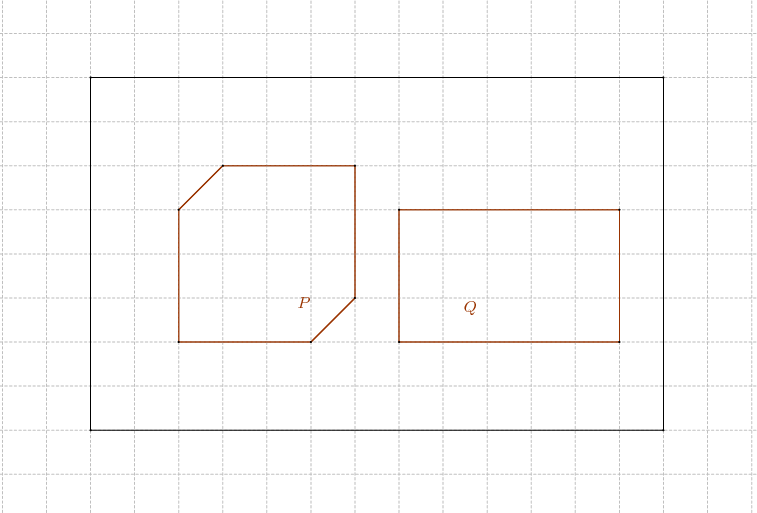
Source: FunctionSpace.org Problem: Given the polygons P and Q as shown in the grid below, cut P into two polygons P1 and P2 such that, when pasted together differently, they form Q. Update ( 21 June 2014 ) : Solution by Varun and Adwait in comments!

Value of Pi - Estimation using Dice

Image
Source: Asked to a friend at Goldman Sachs Quant Interview Problem: Estimate the value of pi using a dice Update: (21 June 2014) Solution posted by Tushar Makkar, 'My first amateur attempt', Satadip, Gaurav Bajaj and me (Pratik) in comments. Thanks